Meeting with Michael Grove at the House of Commons 2016
A memory from five years ago popped up on my Facebook page, while I was working with Rebecca Harris MP’s team to arrange a meeting with the Justice Secretary, Michael Gove PC MP. This was to take place on 20 April 2016, and I was to be accompanied by John Biggin OBE. He had climbed the ranks of the prison system to become a Director and it was an honour to have his support. He had watched my work over the previous 3 years and believed that what we had achieved could change the prison system for the better, by calming prisoners, resulting in less violence and self-harming. Working with staff and management helped the prisoners to engage in a better resume of a prison system.
The date arrived for John and myself to travel from Doncaster to the House of Commons. John had just left the prison system after 30 years, after the disappointment he felt that he could not transfer our project into the Thamesside prison, which was one of the reasons he felt he could not stay in a system that was not helping prisoners to develop their individual needs.
Rebecca and her team greeted us. In just a few minutes we were to meet with The Rt. Hon Michael Gove PC MP. At the last moment there was a change of plan as he had to attend a Brexit meeting and Andrew Selous Under Secretary of Justice took over the meeting. We were ushered into the room and the National Offender Management Service (NOMS) and OCR – Awarding body, were all there to help Cascade courses to be credited within the prison so that we could draw funds for teaching.
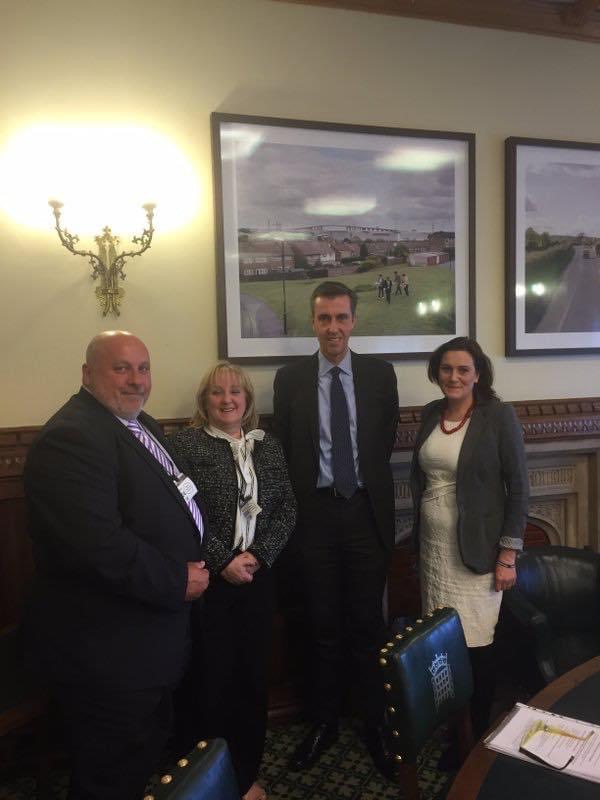
John Biggin OBE, Jackie Hewitt-Main OBE, Andrew Selous Under Secretary of Justice and Rebecca Harris MP
I was placed next to Andrew Selous who took out a large file on myself, all about my work from 2007 to the present day. NOMS spoke about us becoming a part of OCR, which would mean that we would have to put all of our teaching resources online for free. This would not have been financially viable for us to cover costs such as videos, worksheets and books. It would also limit the quality of our teaching in providing trainers with our expertise and teaching methods and not allowing them to really understand our ethos of teaching and learning. John was asked about the work we had produced for his prison and staff having a better understanding of prisoners with learning difficulties/disabilities. Our appointment came to an end, we were advised to work with OCR and NOMS to source a company to credit our courses.
Due to the new education framework Dynamic Purchase System (DPS), Cascade now had to work with The South Yorkshire Community Rehabilitation Company (CRC) to gain funding for our teaching. We had secured an information sharing agreement, and although funding would be given to us at the beginning of the week by Friday all funding would had been used elsewhere.
Looking at this memory of John and I visiting the House of Commons, we had put in so much hard work into changing prisoners’ lives. Cascade never did return to the prison system.
After the channel 4 program the ‘Write Offs’ in 2020, I was involved as the on-screen, off screen and after care support for dyslexia and literacy issues. We had so many people contacting us:
- Pupil referral units
- Functional Skills Tutors – prison
- Undergraduates researching for their dissertations, between mental health, learning disabilities and difficulties within the criminal justice system in the UK
- Journalists looking at dyslexia in prison populations
- Ex-offenders offering to support others
- An ex-offender from the USA, trained as a drug counsellor, wanted to go back into the prison system to help others
Two months after this program in November 2020, the Education Select Committee launched a new enquiry, asking ‘Are Prisoners being left Behind?’ This was the first look into prison education for 15 years.
Of the 32 prisons and Young Offenders’ Institute who were inspected for their education, skills and work provision before the lockdown in March, only nine were judged to be good but no education, work and skills in prisons were considered outstanding.
Although this new way of funding education was allowing more governors to have input for new contracts with specialist courses, no funds materialize for the Cascade.
OFSTED inspectors found that just 16% of prisons had improved their education delivery. Nearly half 48% showed no improvement and, even more worrying, over 35% had got worse.
The issue with the education system in prisons is that the prisoners are reluctant to join any classes. This usually developed from negative experiences from school where any learning difficulties were not addressed, so why would they go back into the same system?
The inspection reports show that many prisons struggle to encourage prisoners into classes, with low attendance and punctuality. Cascade classes, on other hand, had waiting lists, and people would attend with enthusiasm to get back to learning. Our mentors were working for free for the afternoon sessions as the prison management would not pay them, and yet our lessons were always full.
The upsetting thing for The Cascade Foundation was that after this massive shakeup, still the prisoners did not get the help that they really needed, the education providers had not actually met learners’ needs. Just think how many peoples’ lives Cascade could have improved by teaching them how to understand their neurodiversity, which in turn can stop the revolving door of prison.